AI Academic Research Tools
Discover top AI tools that enhance efficiency and accuracy in academic research tasks.

Academic research can often feel like navigating an overwhelming maze of information. With an endless sea of journals, articles, and studies, finding the right resources can be both time-consuming and frustrating. This is where AI tools come in, promising to simplify the research process and enhance productivity.
The landscape of academic research has evolved significantly, and today’s AI tools offer capabilities that go far beyond basic information retrieval. From intelligent literature reviews to data analysis support, these technologies are transforming how researchers gather and synthesize information.
In my quest to uncover the best AI tools for academic research, I spent considerable time experimenting with a variety of platforms. Each one has its unique features, catering to different aspects of the research journey—from organizing notes to generating citations.
As new tools surface regularly, some have already established themselves as indispensable allies for scholars and students alike. Here’s a curated list of the standout AI tools that can elevate your academic research game. Let’s explore what they offer.
The best AI Academic Research Tools
-
46. Science Cast for visualizing complex research data interactively
-
47. Focal for accelerate academic research with ai insights
-
48. Locus for streamline literature review processes.
-
49. Zelma for supporting educational policy analysis
-
50. Satlas for historical imagery analysis for research.
-
51. Cebra for neural dynamic modeling for research insights
-
52. Lumina Chat for ai-driven research paper insights
-
53. Inferent for data analysis for scholarly papers
-
54. Wisio.app for ai support for analyzing research papers
-
55. Talk To Books for efficiently locate relevant book passages.
-
56. Papers Gpt for streamlined data analysis for research projects
-
57. Askdocs for efficient citation extraction for research.
-
58. Promptstacks for collaborative ai research and prompt sharing
-
59. Bluf for extract insights from academic papers rapidly.
-
60. Wizdom.ai for enhanced literature review efficiency
145 Listings in AI Academic Research Tools Available


Science Cast pros:
- Enhance your paper with interactive media
- Create Cast
Science Cast cons:
- The cons of using Sciencecast are not explicitly provided in the document.
- One of the cons of using Sciencecast is the lack of information on specific missing features or drawbacks of the tool.
Science Cast is an innovative platform tailored for those engaged in academic research across various scientific disciplines. By providing interactive media and presentations, it elevates the way complex topics are communicated. Users can dive into a diverse range of subjects, from biology to quantitative finance, ensuring comprehensive coverage of scientific exploration.
One of the key strengths of Science Cast is its focus on specific areas of research. Users can engage with casts covering intricate themes like drug metabolism, ecological patterns post-disturbance, and phylogenetic analysis. This targeted approach enhances users’ understanding by offering multimedia content that is both informative and engaging.
The platform’s design aims to make scientific research more accessible, breaking down complex ideas into digestible formats. Its interactive nature fosters deeper engagement, making it an invaluable resource for scholars and students alike.
With its pricing model starting at $250 per month, Science Cast positions itself as a premium tool for academic research. This investment could yield significant returns for institutions and individuals aiming to broaden their understanding and dissemination of scientific findings.
Science Cast Pricing
Paid plans start at $$250/month and include:
- Bretl algorithm for pre-clinical analysis
- VR and AR ready
- Cygen AI data sorting
- Nuphlux data structures
- Biderectional interface for data import
- Genuslian statistical modules

Focal pros:
- AI-embedded: Work alongside AI to enhance your research workflow with GPT-4.
- Save Forever: Securely save web pages and PDF documents indefinitely.
Focal cons:
- Some pages not found on the website
- Currently only supports desktop, no mobile app available
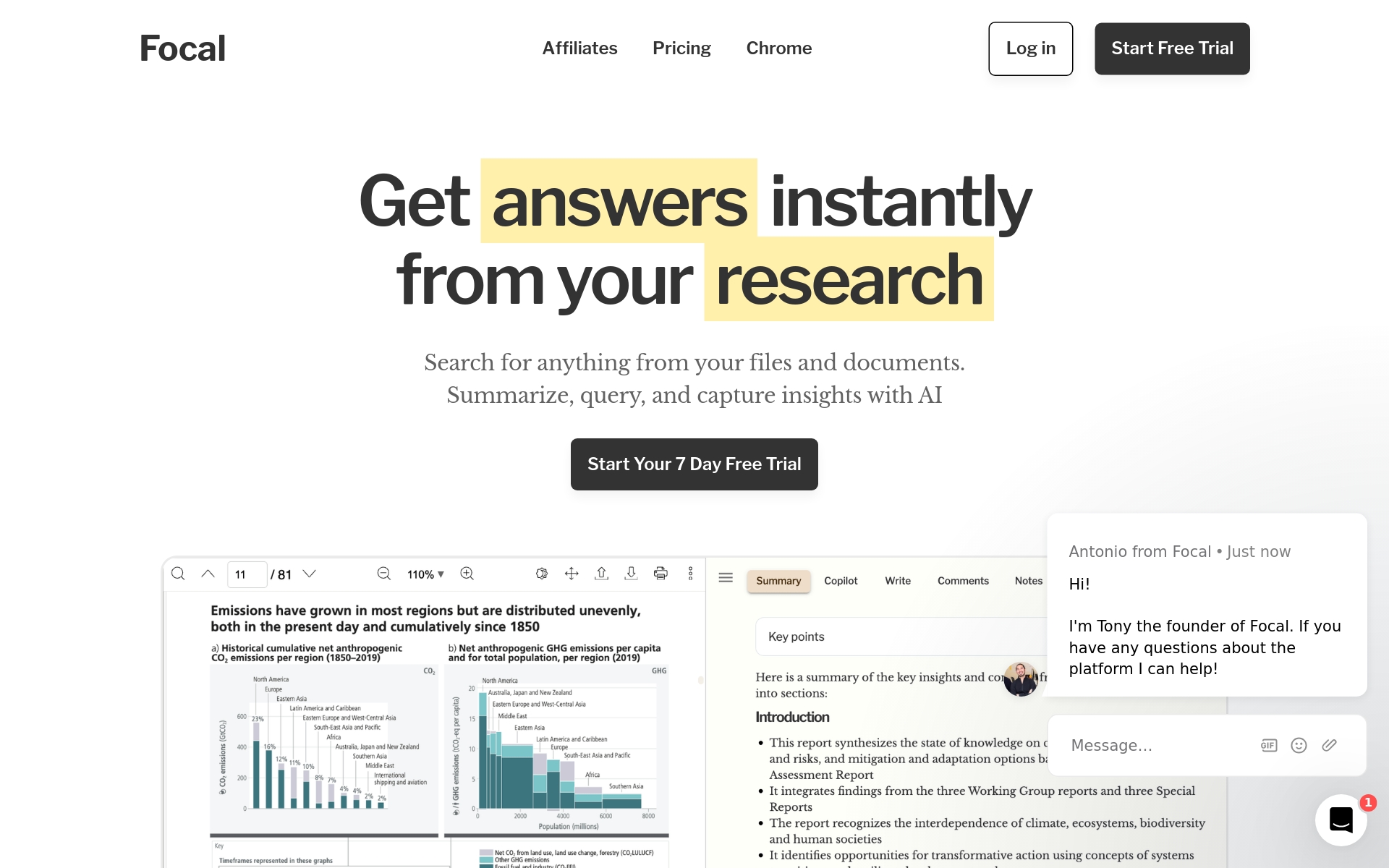
Focal is an innovative academic research tool designed to simplify and enhance the research process for users across various fields. It allows individuals to save and organize articles and papers, while also generating concise summaries that highlight essential information for quick reference. A notable feature of Focal is its ability to categorize and group highlights based on different projects, which promotes efficient sharing and collaboration among team members engaged in research activities. With its user-friendly and minimalist interface, Focal minimizes distractions and maximizes productivity. Additionally, its advanced AI capabilities enable users to conduct precise searches within their stored documents, making it an invaluable resource for knowledge workers in sectors such as finance and legal research. Overall, Focal stands out as a comprehensive tool for improving research efficiency and facilitating the sharing of insights.
Focal Pricing
Paid plans start at $USD/month and include:
- 2,000 pages per month
- Standard AI Model
- PDFs and Web Articles
- AI Summaries
- AI Copilot Sources
- AI Copilot Workspace


Locus pros:
- Research faster with AI assistance
- Summarize entire pages or portions to save time and quickly get the TLDR
Locus is an innovative academic research tool designed to enhance the user experience through the power of AI and large language models. It assists researchers and students in synthesizing information and extracting essential insights from dense academic texts such as articles and textbooks. With features like Smart Search and AI-driven support, Locus helps users quickly locate crucial information and navigate through complex materials with ease.
Additionally, it offers functionalities such as saving favorite content, brainstorming research topics, and studying through interactive note cards, making it a comprehensive solution for efficient research and memorization. Locus is tailored not only for individual learners but also provides professional-grade options with expanded capabilities at various pricing tiers, ensuring it meets the diverse needs of its users. Overall, Locus stands out as a valuable asset for those seeking to streamline their academic research processes and enhance their understanding of intricate subjects.


Zelma pros:
- Specializes in U.S school data
- Enabled plain language queries
Zelma cons:
- Limited to U.S. data
- No collaborative features
Zelma is an innovative research tool designed to assist educators, researchers, and policymakers in navigating the complex landscape of U.S. school testing data. By utilizing advanced artificial intelligence, Zelma simplifies the process of querying extensive educational datasets, allowing users to obtain valuable insights with ease. Its user-friendly interface enables individuals to pose questions in plain English, making it accessible for those without a technical background. Through Zelma, users can better understand educational trends, evaluate assessment outcomes, and draw informed conclusions that contribute to improved educational practices and policies. This powerful research assistant bridges the gap between data and decision-making, empowering stakeholders in the education sector to make evidence-based choices.


Satlas pros:
- AI-Annotated Imagery: Satellite images annotated with AI for accurate observations.
- Timeframe Navigation: Explore historical satellite imagery to witness environmental changes over time.
Satlas cons:
- No specific cons of using Satlas were mentioned in the document provided.
Satlas stands out as a cutting-edge tool designed for those involved in academic research and education. Leveraging AI-annotated satellite imagery, it provides a unique lens through which users can observe the dynamic changes our planet experiences over time. This innovative approach allows researchers to gain insights into environmental shifts, urban development, and a myriad of other geographical transformations.
One of Satlas's key features is its intuitive interface, making it accessible for educators, researchers, and enthusiasts alike. The user-friendly design encourages exploration and engagement, enabling researchers to easily navigate historical imagery to track changes across different landscapes. This is particularly valuable for studies related to climate change, urbanization, and land use.
The platform's ability to offer geospatial exploration means that users can access satellite imagery from diverse locations globally. This feature supports comparative analyses, allowing researchers to observe global patterns and localized phenomena with ease. Additionally, the AI annotations enhance the precision of observations, providing a rich context for understanding complex environmental data.
Overall, Satlas serves as a robust resource for academic researchers. Its combination of advanced satellite technology and artificial intelligence cultivates a comprehensive understanding of Earth's evolving conditions. Whether for teaching, research projects, or personal interest, Satlas empowers users to monitor and appreciate the intricate changes our planet undergoes.


Cebra pros:
- Non-Linear Embedding Techniques: Leverages advanced non-linear methods to merge behavioral and neural data revealing dynamic neural activity.
- Flexible Application: Suitable for diverse datasets including calcium imaging and electrophysiology and across various sensory and motor tasks.
Cebra cons:
- No cons available in the provided documents.
- No specific cons or missing features of using Cebra were mentioned in the provided documentation.
CEBRA (Comprehensive Encoding of Behavioral and Regulatory Activity) stands out as a revolutionary machine-learning tool tailored for academic research, particularly in the realms of behavioral and neural data analysis. Its innovative approach allows researchers to identify hidden structures within time series data, unveiling intricate patterns in variability that traditional methods may overlook.
A notable advantage of CEBRA is its capacity for simultaneous decoding of neural activity from the visual cortex while reconstructing video experiences. This feature enhances our understanding of how brain activity correlates with sensory processing and perception.
The method employs non-linear techniques, allowing researchers to merge various datasets, including calcium imaging and electrophysiology. This versatility promotes a richer exploration of complex sensory and motor tasks, making it a valuable resource for interdisciplinary studies.
One of CEBRA's standout features is its label-free decoding ability, which enables the reconstruction of complex kinematic and visual elements without reliance on external labels. This capability streamlines the research process, allowing for a focus on intrinsic data relationships.
Additionally, CEBRA supports multi-session analysis, providing consistency in latent space exploration. This is particularly beneficial for robust hypothesis testing across multiple experiments and datasets, facilitating deeper insights into neural representations and connectivity over time.
In sum, CEBRA is rapidly establishing itself as an essential tool for researchers seeking to deepen their understanding of brain function and behavior. Its unique features and applications make it a prime choice for those engaged in cutting-edge academic research.

Lumina Chat pros:
- Lumina Chat is an AI-powered search engine for detailed answers from journal articles and research papers.
- Provides a ChatGPT-like experience tailored for the scientific community.
Lumina Chat is a groundbreaking AI-powered search engine specifically designed for researchers. It offers a robust platform that enables users to quickly access in-depth information from a vast array of journal articles and research papers. With Lumina Chat, academic professionals can streamline their research process and delve deeper into relevant studies without the usual hassle of sifting through countless sources.
One of the standout features of Lumina Chat is its ability to scan full-text sources, analyze research findings, and provide interactive citations. This allows researchers to validate their results with ease, enhancing the overall reliability of their work. The interface is user-friendly, making complex searches feel like a seamless conversation, much like chatting with a knowledgeable peer.
In addition to its extensive database, Lumina Chat includes a generous 100GB personal storage feature. Users can conveniently upload and search through their own files and papers, making it an invaluable tool for individual researchers and academic institutions alike. This feature not only helps in organizing research materials but also ensures that users have everything they need at their fingertips.
For those who prioritize efficiency and depth in academic research, Lumina Chat stands out as an essential resource. It combines advanced AI technology with a focus on the scientific community, making it a go-to platform for anyone looking to elevate their research capabilities. To learn more about its offerings, visit the official website at Lumina Chat.

Inferent pros:
- Real-world Data
- Large-Scale Datasets
Inferent cons:
- The cons of using Inferent are not explicitly listed in the provided document.
Overview of Inferent
Inferent is an innovative platform designed to enhance the academic research process by providing researchers with tools for efficient data analysis and knowledge synthesis. It specializes in leveraging advanced algorithms to analyze large datasets, allowing users to uncover patterns, trends, and insights that would be difficult to identify through manual methods.
The platform supports various academic disciplines, making it versatile for researchers in fields such as social sciences, natural sciences, and humanities. Inferent also incorporates features for collaborative work, enabling teams to share findings, annotations, and methodologies seamlessly in a centralized workspace.
In addition to its analytical capabilities, Inferent prioritizes user experience by offering intuitive interfaces and customizable dashboards. These features facilitate the visualization of complex data, transforming raw information into comprehensible graphs and reports that can aid in hypothesis formation and scholarly communication. Ultimately, Inferent empowers researchers to streamline their workflow, improve the rigor of their analysis, and enhance the overall quality of their academic output.


Wisio.app pros:
- AI suggestions for improving writing quality
- Comprehensive database of relevant scientific papers
Wisio.app stands out as a specialized AI writing assistant tailored for the scientific community. With its robust features, it aims to enhance the clarity and precision of scientific writing. This tool is particularly valuable for researchers looking to improve their manuscripts with alternative phrasings, synonyms, and diverse sentence structures.
One of Wisio.app’s noteworthy capabilities is its access to a comprehensive database of relevant scientific papers. This feature empowers users to integrate up-to-date research and references seamlessly into their writing, ensuring their work is well-informed and relevant.
Additionally, Wisio.app offers translation services into multiple languages, making it an ideal resource for international collaboration and communication in science. This feature broadens the accessibility of research and helps scientists share their findings across linguistic boundaries.
The user-friendly interface caters to both seasoned researchers and newcomers in the scientific field. This simplicity ensures that all users can navigate the platform with ease, focusing on their writing rather than grappling with complicated software. Wisio.app undoubtedly contributes to the academic research landscape by enhancing the quality and accessibility of scientific communication.


Talk To Books cons:
- Missing features compared to other AI search engine tools that are actively developed
- Talk To Books has been closed down, so it is no longer available for use.
Talk To Books is an innovative platform designed to enhance the literary research experience by allowing users to interactively explore ideas and discover books. By simply stating a thought or posing a question, individuals can access curated passages from a diverse range of texts, thanks to advanced AI technology that supports semantic matching and retrieval. Since its launch in 2018, the platform has attracted significant interest for its ability to facilitate meaningful conversations about literature, offering a unique approach to exploring content that traditional search methods may not provide. By engaging millions of users, Talk To Books exemplifies how artificial intelligence can transform academic research into a more interactive and insightful journey, broadening the horizons of literary inquiry.


Papers Gpt pros:
- Vast integration capabilities with various data sources
- Customizable AI, yielding more specific and accurate answers
Papers Gpt cons:
- Requires technical know-how to integrate data sources effectively
- Limited mobile compatibility; best accessed on larger screens
Papers GPT is an innovative AI tool tailored specifically for academic researchers. It streamlines the process of collecting and synthesizing relevant scholarly articles, enabling users to focus on their analysis rather than the tedious task of literature review. By integrating various academic databases, it allows for efficient data gathering tailored to individual research needs.
Designed with user-friendliness in mind, Papers GPT features an intuitive interface that enhances accessibility for researchers at any stage of their academic journey. Whether you're a seasoned scholar or a student, the tool makes it easier to navigate complex topics and find the most pertinent information.
One of the standout functionalities of Papers GPT is its ability to generate summaries and insights from selected papers. This feature not only saves time but also ensures that researchers distill key findings effectively. By automating the extraction of critical data, it empowers users to make data-driven decisions swiftly.
While primarily focused on desktops, Papers GPT's capabilities are a boon for those frequently engaged in academic writing or research projects. The tool operates on a freemium model, providing basic functionalities for free, and offers subscription plans that unlock advanced features for dedicated researchers.
Ultimately, Papers GPT enhances productivity in academic settings by providing tailored support and integrating seamlessly into existing research workflows. If you're looking for a comprehensive tool that can elevate your academic research efforts, it’s worth considering.


Askdocs pros:
- Supports multiple document formats
- Handles YouTube link processing
Askdocs cons:
- No mobile app support
- Limited file upload size
AskDocs is an innovative AI assistant tailored specifically for academic research, streamlining the management of reading and research tasks. It is adept at processing a wide range of document formats, including PDF, DOCX, TXT, CSV, and EPUB, as well as handling YouTube links. By utilizing advanced natural language processing models like GPT-3.5 and GPT-4, AskDocs can efficiently summarize complex information, extract relevant answers, and provide precise citations directly from the source materials.
This tool excels in enabling multi-document processing, allowing researchers to retrieve data quickly and accurately, which significantly boosts productivity. Its flexible questioning capabilities cater to diverse research needs, making it an ideal resource for academic investigations, legal document analysis, and content comprehension. In essence, AskDocs is designed to enhance the workflow of researchers by facilitating rapid access to essential information and summarizing key insights from intricate documents.
Askdocs Pricing
Paid plans start at $9/month and include:
- Greater volume of queries
- Document reading requirements
- Group Document Questioning


Promptstacks pros:
- Comprehensive platform for learning about Generative AI, ChatGPT, and other large language models
- Over 19,000 people already on board, making it a popular resource
Promptstacks cons:
- No specific cons or missing features of using Promptstacks were found in the provided documents.
- The page you are looking for does not exist on Promptstacks website
Promptstacks serves as a valuable resource for those interested in the rapidly changing landscape of Generative AI. This platform fosters a collaborative environment where users can share insights, tips, and strategies related to prompt engineering, catering to both newcomers and seasoned professionals in the field. With a wealth of in-depth tutorials and articles, Promptstacks addresses a wide array of topics, ranging from foundational knowledge of tools like ChatGPT to more complex discussions on language modeling. The platform not only enhances individual learning but also encourages engagement and knowledge exchange within its vibrant community, making it an essential hub for anyone looking to deepen their understanding of artificial intelligence.


Bluf pros:
- Browse Efficiently and Boost Your Understanding
- Summarize Anything
Bluf cons:
- Pricing tiers may limit the number of prompts and words per page for users with heavier usage needs
- Limited browser support at the moment (available on Chrome and Firefox only)
BLUF (Bottom Line Up Front) is an innovative AI-driven browser extension designed to streamline the process of understanding and summarizing information from various online content types, including websites, PDF documents, and YouTube videos. This tool enables users, especially in academic settings, to efficiently distill essential information and grasp complex concepts through clear, concise explanations and key highlights.
Ideal for researchers, students, and academics, BLUF transforms the way users interact with dense materials by providing quick access to critical insights, thus enhancing study efficiency and comprehension. Its integration with multiple content mediums makes it particularly versatile, catering to a wide range of academic needs—from analyzing scholarly articles to preparing engaging discussions.
BLUF respects user privacy by minimizing data retention and eliminating the storage of specific query contents, ensuring a secure browsing experience. Available on both Chrome and Firefox, this extension presents a valuable resource for anyone looking to maximize their understanding of academic materials. For further assistance, users can reach out to the BLUF support team at support@bluf.ai.
Bluf Pricing
Paid plans start at $Free/month and include:
- 25 prompts / month
- 20,000 words / page
- Standard: 4 / month, 200 prompts / month, 50,000 words / page
- Professional: 10 / month, Unlimited prompts, 200,000 words / page

Wizdom.ai pros:
- Comprehensive Research Insights
- Trend Identification
Wizdom.ai is a cutting-edge platform designed to transform the way research is conducted and managed in the global ecosystem. Leveraging advanced artificial intelligence, it delivers critical insights and intelligence tailored for a diverse range of users including researchers, academic institutions, publishers, organizations, funders, and government entities. By analyzing extensive datasets, Wizdom.ai provides users with a holistic view of the research landscape, helping them to identify emerging trends, uncover collaboration opportunities, and analyze grant information. This innovative tool enhances overall research productivity by equipping users with the necessary knowledge to navigate challenges and optimize their efforts effectively.
Related Categories
- Academic Research Tools
- Academic Writing Tools
- AI Detectors
- Assignment Tools
- Chemistry Tools
- Citation Tools
- College Students Tools
- Dissertation Writing Tools
- Essay Writing Tools
- Graduate Students Tools
- Grammar Checkers
- Language Learning Tools
- Law Students Tools
- Lesson Planning Tools
- Mathematics Tools
- Medical Students Tools
- Paraphrasing Tools
- PDF Chat Tools
- PhD Students Tools
- Plagiarism Checkers
- Report Writing Tools
- School Tools
- Science Tools
- Students Tools
- Summarizers
- Teachers Tools
- Thesis Writing Tools
- University Students Tools